
Emergency calls analysis reveals opportunities to save more lives
Prompt CPR increases survival chances fourfold
/filters:format(webp)/filters:no_upscale()/prod01/cdn/media/stirling/news/news-centre/2026/jan-26/1200X630_CPR_iStock-182515607.jpg)
Analysis of emergency calls to the Scottish Ambulance Service has identified opportunities to increase the number of people who receive lifesaving cardiopulmonary resuscitation (CPR).
The most important factor determining survival from out-of-hospital cardiac arrest (OHCA) is prompt CPR by bystanders – it increases survival up to fourfold, and it is estimated that chances of survival decrease by 10% for every minute without CPR.
New analysis led by University of Stirling researchers, in partnership with the Scottish Ambulance Service, has shown the most common barriers to CPR are communication challenges, such as poor signal and noise (48%), high emotion (45.5%) and physical challenges (38.5%).
Dr Barbara Farquharson, Associate Professor at the University of Stirling, said: “When someone collapses because their heart has stopped, they will die unless someone with them begins CPR immediately but, unfortunately, CPR is often not provided quickly enough.
“We analysed 200 ambulance calls to understand the main barriers to people starting CPR and found that most people find themselves needing to do CPR on a loved one, which is very distressing.
“As well as distress, people encountered various physical challenges, they were concerned about doing harm, and that it might be too late or futile – all issues that delayed CPR. Callers who said they did not know how to do CPR also took longer to start CPR.”
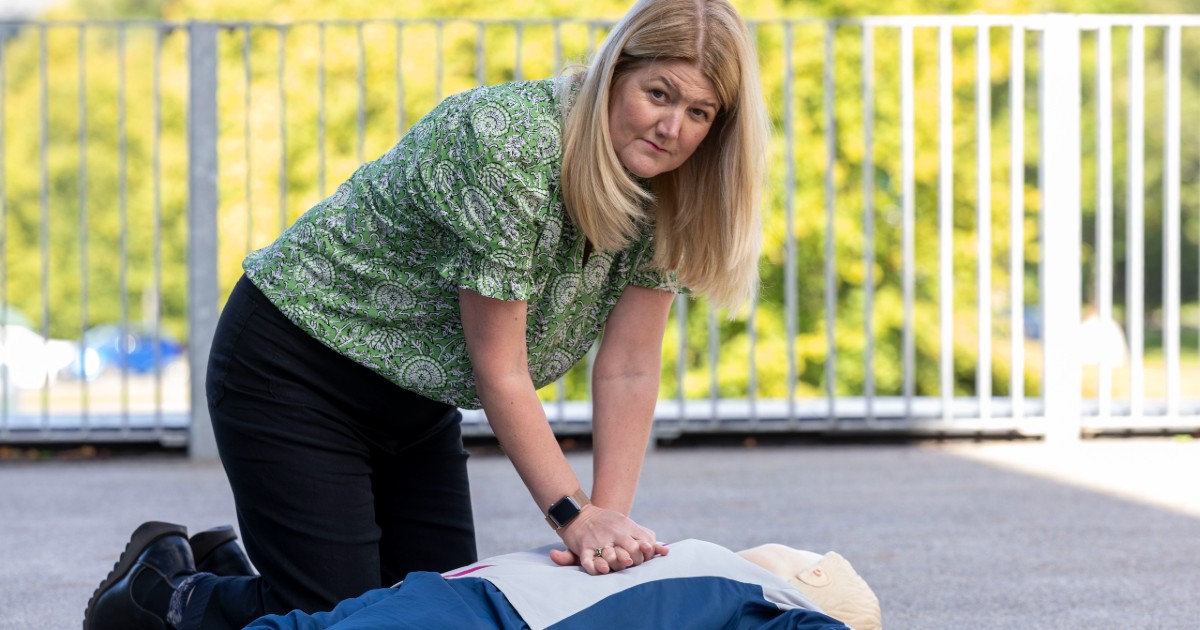 Dr Barbara Farquharson, Associate Professor at the University of Stirling, demonstrates CPR
Common barriers
A random sample of 200 calls was selected from around 11,275 potentially eligible calls between January 2019 and December 2020. The people experiencing cardiac arrest were male in 122 calls (61%), female in 78 (39%), and ages ranged from a baby to over 90 years old, with most being in their 40s to 80s.
Analysis found that the median time to position the patient flat was 40 seconds and to initiate CPR an additional 50 seconds. A key finding is that different factors play a role in each of these key behaviours. Researchers who carried out the analysis now plan to work with call handlers, who are experts in dealing with these distressing calls, to find ways to address the most common barriers.
Dr Farquharson said: “We think that by working alongside call handlers, who deal with these emergencies on a daily basis, we can try techniques to address the specific concerns for individual callers - this could help achieve earlier CPR and more people would survive.”
If a person is unconscious and not breathing, or not breathing normally, official advice is to call 999 and begin CPR – chest compressions with the heel of the hand in the centre of the patient’s chest at a rate of 2 per second.
Dispatcher-assisted CPR (DA-CPR) or telephone/telecommunicator-assisted CPR (T-CPR), where trained call handlers provide real-time instructions to callers about how to perform CPR, increases the provision of CPR and increases survival.
However, even in settings where DA-CPR is well established, research has shown that up to a third of bystanders do not deliver CPR even when in receipt of instructions over the telephone.
Specific concerns
Dr Farquharson said: “Identifying and addressing the specific concerns for individual callers at each stage is likely to help facilitate earlier CPR.
“Many of the barriers to CPR are potentially modifiable with behavioural techniques, offering a promising avenue for intervention.
“Research exploring how best academics and the Ambulance Service can work together to discover the best techniques and to evaluate effectiveness is the next clear step in saving more lives through bystander CPR.”
Dr Gareth Clegg, Associate Medical Director, Scottish Ambulance Service, and Senior Lecturer at the University of Edinburgh said: “This research provides an excellent foundation for future work, supporting callers who are hesitant in providing CPR.
“I would also encourage the public to visit savealife.scot to find out how they can be trained on this life-saving skill. An out-of-hospital cardiac arrest can happen to anyone at any time and with most happening at home, knowing CPR and being confident to act could save a loved one’s life.”
The study was published today in the Emergency Medicine Journal. The authors are Dr Farquharson and Dr Catherine Best (University of Stirling). The co-investigators are Dr Gareth Clegg (Scottish Ambulance Service, University of Edinburgh) and Professor Marie Johnston (University of Aberdeen). The Scottish Ambulance Service is a partner in the study.
The research was funded by a British Heart Foundation NMAHP Career Development Fellowship, and the Laerdal Foundation.