
New project will map Fife’s mining heritage
University of Stirling launches Fife Miners’ Memorial Way
/filters:format(webp)/filters:no_upscale()/prod01/cdn/media/stirling/news/news-centre/2026/mar-26/1.-Iain-Chalmers,-Richard-Baker-MP,-Dr-Catherine-Mills.jpg)
A new project celebrating Fife’s mining heritage will map memorials, monuments, murals, and artworks that commemorate the lives lost to mining and the communities shaped by the industry.
The Fife Miners’ Memorial Way is being developed by the University of Stirling’s Eco-Museum of Scottish Mining Landscapes, supported by The National Lottery Heritage Fund.
The project offers local communities the opportunity to help shape a long-distance walking and cycling route linking memorials across the Kingdom.
Led by Dr Catherine Mills, Senior Lecturer in Environmental History at the University of Stirling, the project responds to growing community interest in recording personal stories and local histories alongside physical memorials.
Dr Mills said: “Living in Fife and having worked with mining communities since 2016, I am very aware of the importance of miners’ memorials, and I am delighted that the Fife Miners’ Memorial Way is now being brought to life.”
Dedicated memorial way
The idea for the Fife route came from former miner Iain Chalmers, who suggested creating a dedicated memorial way during a public event linked to the Before and After Coal exhibition at Kirkcaldy Galleries.
Iain Chalmers said: “In Fife we are proud to have the Pilgrims Way that follows the route pilgrims took through Fife to St Andrews. With the memorials, cairns and murals in the former mining towns and villages I always felt that the same principle could be applied, with a route that connects all the mining areas in the Kingdom along with the stories of each memorial. When I mentioned this at a talk in Kirkcaldy Galleries the response was very positive indeed, and I’m pleased that my dream is becoming a reality.”
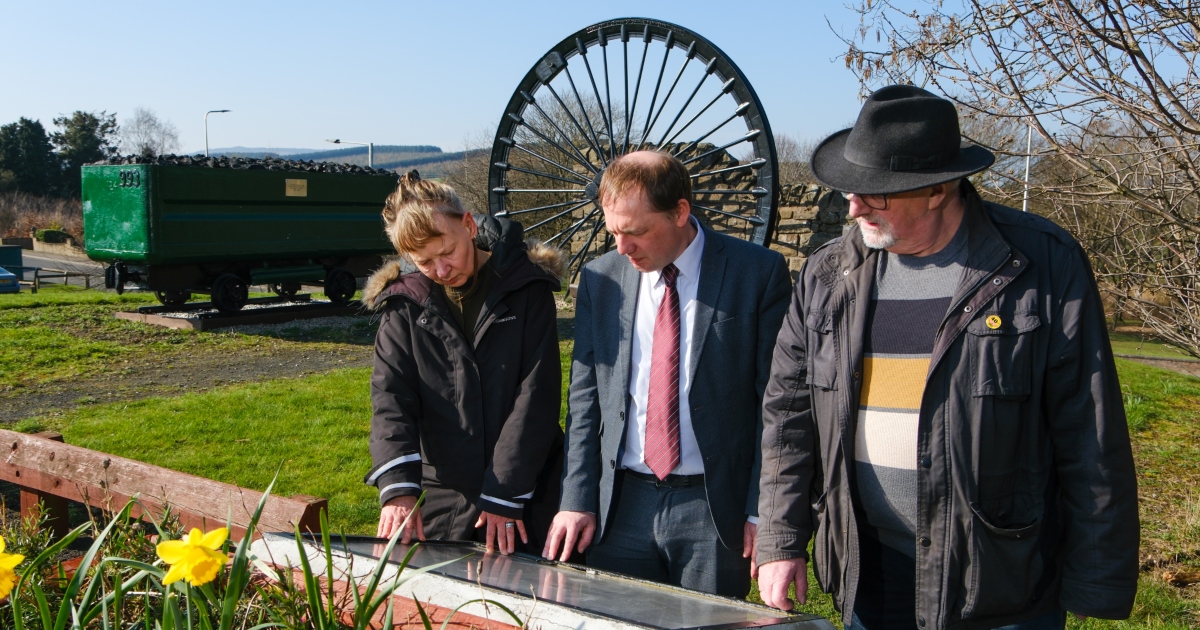 (l-r) Dr Catherine Mills, Richard Baker MP and Iain Chalmers
Sites already added include memorials in Valleyfield, Blairhall, and a new stained-glass memorial in Kincardine which marks the 40th anniversary of the 1984–85 miners’ strike. Sites identified for inclusion include memorials in Cowdenbeath, Cardenden, Glencraig, Kelty, Kirkcaldy, Dysart, East Wemyss, Lochore Meadows Country Park, and a mural in Comrie.
Artist Keira McLean, who led on the creation of the Kincardine memorial, said: “It was an amazing experience working with members of the Kincardine community to create this lasting stained-glass tribute to the 1984 miners’ strike. Our group was made up of striking miners, families of miners, citizen archivists, and historians. Together we researched, designed, and made Scotland's only stained-glass window commemorating the miners' strike. The window, now housed in Kincardine Library, is enjoyed by the whole community. I hope in some small way this project gives voice to those affected and mistreated during the strike and reinforces the power of art as a way of sharing our struggles and histories."
Artist Paul McGinty, whose works are inspired by the coalmining industry in Fife, said: “As a Fife-based abstract painter with family history roots connected to the mining industry, my paintings seek to recognise, celebrate, and preserve mining heritage for future generations. I am delighted to be involved in this project, which will help realise those objectives.”
Locals are encouraged to submit photographs, locations and personal stories connected to memorials important to them or their community.
Proud mining history
Richard Baker MP for Glenrothes and Mid Fife said: “It’s impossible to think about Fife without talking about our proud mining history, which was such a major driving force in shaping our communities.
“Even though the industry has fallen silent, our mining heritage feels very much a part of our collective consciousness still.
“You don’t need to walk far to find someone who either worked as or had a close relative who was a miner, and the losses and hardships our mining communities endured through the years are still keenly remembered.
“The Fife Miners’ Memorial Way is an excellent way to connect these stories and ensure our history continues to remain relevant.
“It creates a literal journey through our past and I’m certain the route will be fascinating and informative both to visitors and to Fifers who lived and breathed those times.”
The mapping phase will continue until summer 2026, with plans to work with local walking and cycling groups to create a connected route through Fife. Contributions can be submitted here, or sent via email to mining-landscapes@stir.ac.uk.
Opportunities for communities
The Eco-Museum of Scottish Mining Landscapes is the first industrial eco-museum in Scotland, created with funding from The National Lottery Heritage Fund.
The virtual museum focuses on the Scottish Midland coalfield which spans an area from Ayrshire to Fife, with visitors able to download new cycling and walking routes created by local communities to both commemorate their mining history, heritage, and a sense of place.
Caroline Clark, The National Lottery Heritage Fund Director for Scotland, said: “Fife has hugely important mining and industrial heritage.
“Thanks to National Lottery players, this grant will enable the Fife Miners’ Memorial Way project to develop this new long-distance route and deliver opportunities for communities along its length to get involved, enabling Fife voices to tell Fife’s story.”